Big O, Big Θ, Big Ω
What You'll Learn
- ✅ What asymptotic notation is and why we need it
- ✅ The difference between Big O (upper bound), Big Ω (lower bound), and Big Θ (tight bound)
- ✅ How to read and write complexity expressions
- ✅ The most common complexity classes and what they feel like at scale
- ✅ How to determine which notation to use when analysing an algorithm
- ✅ Common misconceptions and traps
When we analyse an algorithm, we don't care about exact runtimes — those depend on hardware, language, and input quirks. Instead, we ask: how does the runtime grow as input size grows? Asymptotic notation gives us a precise mathematical language to answer that question.
New to Complexity Analysis?
Start by thinking of Big O as a speed limit sign — it tells you the worst it can get, not how fast you're going right now. Once that clicks, Big Θ and Big Ω fall into place naturally.
Already know the basics?
Focus on the Formal Definitions and Choosing the Right Notation sections — most developers use these terms loosely and mix them up in interviews.
Keep in mind
In everyday conversation (and most interviews), people say "Big O" when they really mean Big Θ (tight bound). Knowing the difference matters for technical accuracy — and for impressing interviewers.
The Three Notations at a Glance
graph LR
    A["f(n) — actual runtime"] --> B["Big O: f(n) = O(g(n))\nUpper bound\n'at most this bad'"]
    A --> C["Big Ω: f(n) = Ω(g(n))\nLower bound\n'at least this good'"]
    A --> D["Big Θ: f(n) = Θ(g(n))\nTight bound\n'exactly this order'"]

    style B fill:#ff6b6b,color:#fff
    style C fill:#51cf66,color:#fff
    style D fill:#339af0,color:#fff
1️⃣ Why Asymptotic Notation?
Consider two sorting algorithms:
# Algorithm A: always does exactly 3n² + 5n + 12 operations
# Algorithm B: always does exactly 100n + 200 operations
n = 10:     A = 362 ops      B = 1,200 ops   → A wins
n = 100:    A = 30,512 ops   B = 10,200 ops   → B wins
n = 1,000:  A = 3,005,012    B = 100,200      → B wins by 30x
n = 1,000,000: A ≈ 3×10¹²   B ≈ 10⁸          → B wins by 30,000x
The growth rate of the dominant term is what matters at scale. We drop constants and lower-order terms:
The golden rule
Drop constants. Drop lower-order terms. Keep only the fastest-growing term.
2️⃣ The Complexity Classes
 Growth rate comparison of common complexity classes — HackerEarth
| Class | Name | Example |
|---|---|---|
| O(1) | Constant | Array index access, hash map lookup |
| O(log n) | Logarithmic | Binary search, balanced BST ops |
| O(n) | Linear | Linear search, single loop |
| O(n log n) | Linearithmic | Merge sort, heap sort |
| O(n²) | Quadratic | Bubble sort, nested loops |
| O(n³) | Cubic | Naive matrix multiplication |
| O(2ⁿ) | Exponential | Recursive Fibonacci, subset generation |
| O(n!) | Factorial | Permutation generation, brute-force TSP |
3️⃣ Formal Definitions
Big O — Upper Bound
f(n) = O(g(n)) means there exist positive constants c and n₀ such that:
f(n) ≤ c · g(n)for alln ≥ n₀
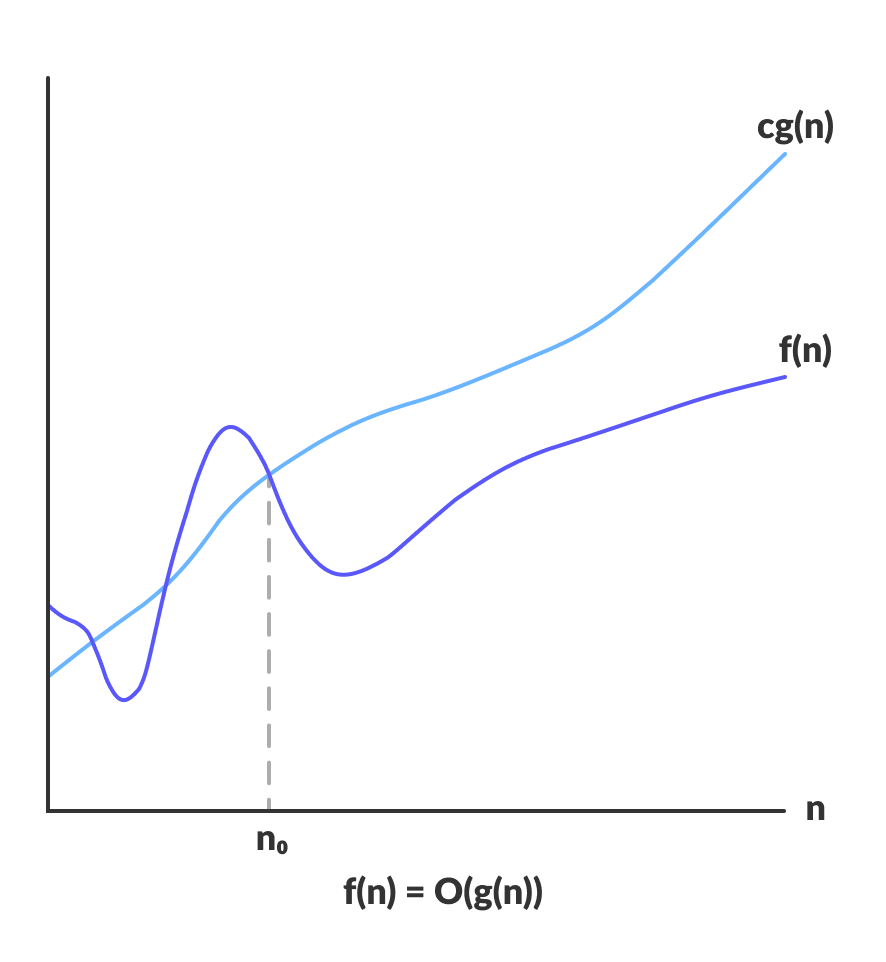 f(n) stays below c·g(n) for all n past n₀ — source: Programiz
Example: f(n) = 3n + 5
- Choose c = 4, n₀ = 5: 3n + 5 ≤ 4n for all n ≥ 5 ✅
- Therefore: f(n) = O(n)
Big Ω — Lower Bound
f(n) = Ω(g(n)) means there exist positive constants c and n₀ such that:
f(n) ≥ c · g(n)for alln ≥ n₀
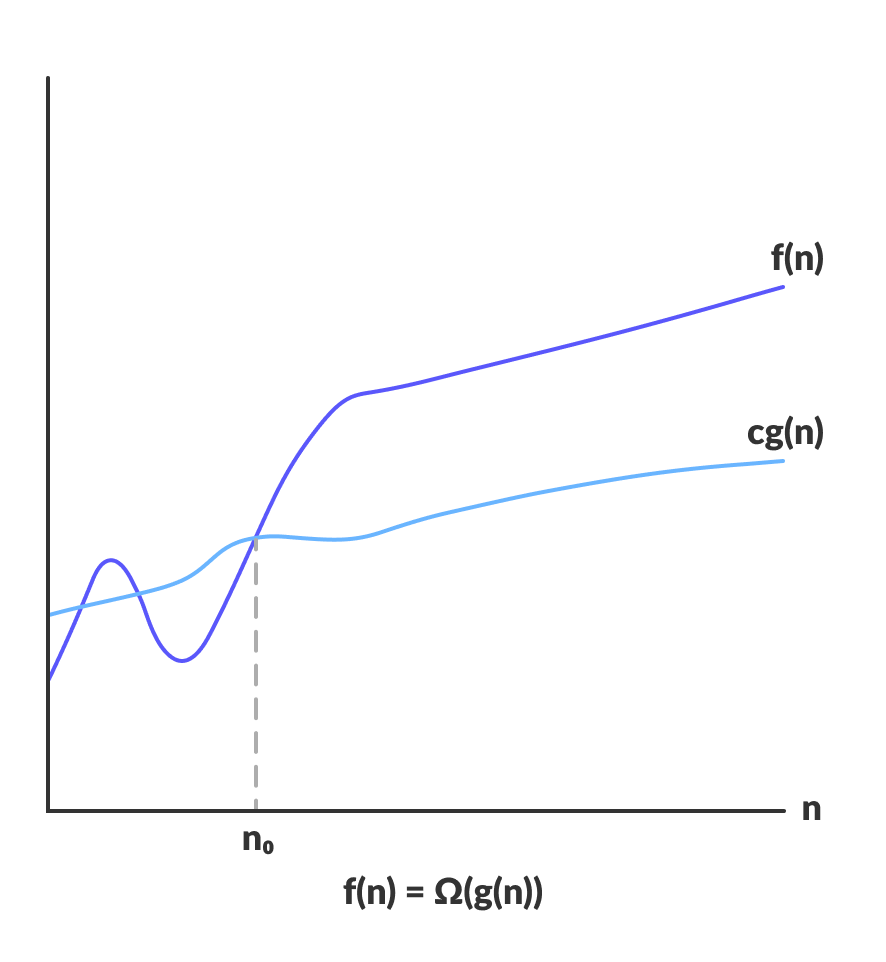 f(n) stays above c·g(n) for all n past n₀ — source: Programiz
Example: Any comparison-based sort is Ω(n log n) — you can't do better than that in the worst case.
Big Θ — Tight Bound
f(n) = Θ(g(n)) means f(n) = O(g(n)) AND f(n) = Ω(g(n))
Equivalently: there exist constants c₁, c₂, n₀ such that:
c₁ · g(n) ≤ f(n) ≤ c₂ · g(n)for alln ≥ n₀
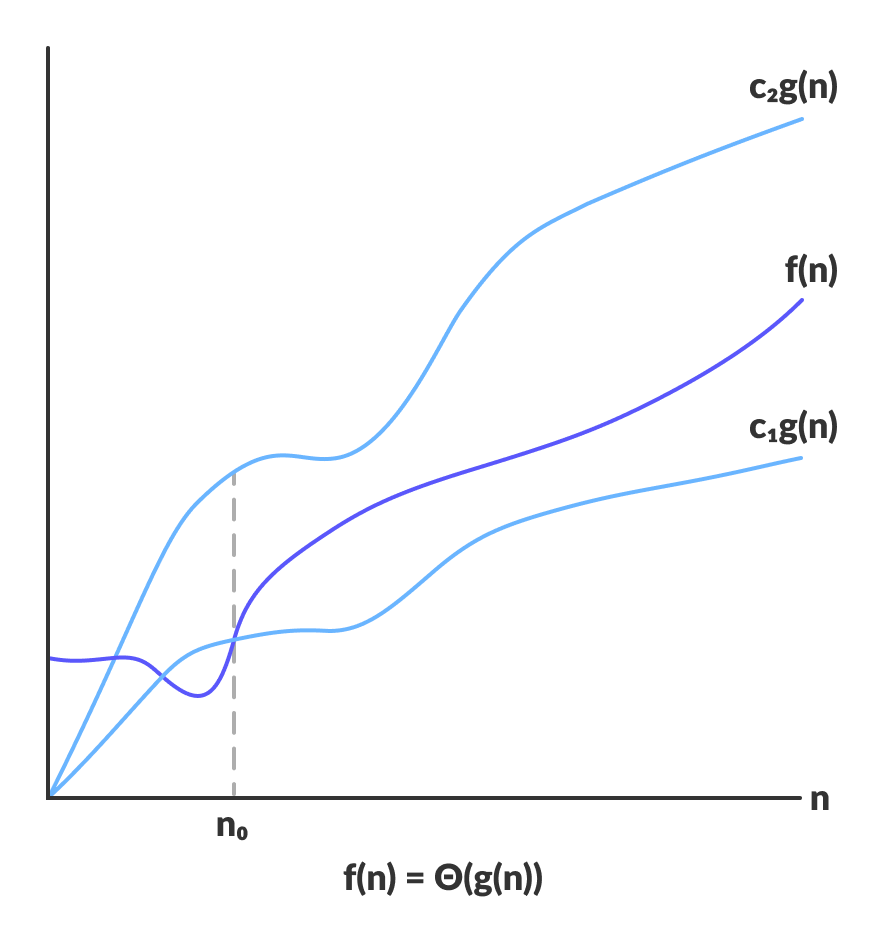 f(n) is sandwiched between c₁·g(n) and c₂·g(n) for all n past n₀ — source: Programiz
Example: f(n) = 3n + 5 = Θ(n) because it's both O(n) and Ω(n).
4️⃣ Big O in Code
5️⃣ Analysing Cases: Best, Average, Worst
An algorithm can behave differently depending on the input. We analyse three cases:
def linear_search(lst, target):
    for i, val in enumerate(lst):
        if val == target:
            return i    # found — stop early
    return -1
Case Analysis for Linear Search
──────────────────────────────────────────────────────
  Best case    →  target is lst[0]   →  1 comparison   →  Ω(1)
  Average case →  target is in middle → n/2 comparisons → Θ(n)
  Worst case   →  target not in list →  n comparisons   →  O(n)
──────────────────────────────────────────────────────
  Big O  describes the WORST case upper bound
  Big Ω  describes the BEST case lower bound
  Big Θ  describes the TIGHT bound (when best ≈ worst)
──────────────────────────────────────────────────────
O and Ω are bounds, not cases
This is one of the most common confusions. Big O is not the worst case — it's an upper bound. You can correctly say linear_search = O(n²) (it's true but loose). Big O just says "it won't grow faster than this." The tight worst-case bound is Θ(n).
6️⃣ Simplification Rules
# Rule 1: Drop constants
O(3n)     →  O(n)
O(500)    →  O(1)
O(2n²)   →  O(n²)

# Rule 2: Drop lower-order terms
O(n² + n)       →  O(n²)
O(n log n + n)  →  O(n log n)
O(2ⁿ + n¹⁰⁰)   →  O(2ⁿ)

# Rule 3: Sequential steps → ADD
def two_loops(n):
    for i in range(n):    # O(n)
        pass
    for j in range(n):    # O(n)
        pass
# Total: O(n) + O(n) = O(2n) → O(n)

# Rule 4: Nested steps → MULTIPLY
def nested_loops(n):
    for i in range(n):        # O(n)
        for j in range(n):    # O(n)
            pass
# Total: O(n) × O(n) = O(n²)

# Rule 5: Different inputs → different variables
def two_arrays(a, b):
    for x in a:    # O(a)
        pass
    for y in b:    # O(b)
        pass
# Total: O(a + b)  ← NOT O(n), they're separate inputs!
Sequential vs Nested
The + vs × distinction is critical. Sequential loops add; nested loops multiply. This single rule explains why two nested loops over n items is O(n²), not O(2n).
7️⃣ Choosing the Right Notation
You want to give a guarantee — the algorithm will not be worse than this.
- Reporting worst-case performance to stakeholders
- Comparing algorithms where the worst case matters (e.g. real-time systems)
- Most interview and textbook contexts — it's the default notation
You want to give a lower bound — no algorithm can do better than this.
- Proving theoretical limits: "any comparison sort requires Ω(n log n)"
- Showing a problem is inherently hard
- Proving your algorithm is optimal
8️⃣ Common Traps and Misconceptions
# ❌ Trap 1: O(n) doesn't mean "fast"
# O(n) with n = 10⁹ is still a billion operations.
# Constants matter in practice even if we drop them theoretically.

# ❌ Trap 2: Confusing Big O with worst case
# These are independent. Big O is a bound, not a case.
# Quicksort is O(n²) worst case, but also O(n log n) average case.
# Both statements use Big O for different scenarios.

# ❌ Trap 3: Same variable for different inputs
def func(a, b):
    for x in a:      # this is O(|a|), not O(n)
        for y in b:  # this is O(|b|), not O(n)
            pass
# Correct: O(|a| × |b|)  — NOT O(n²) unless |a| == |b|

# ❌ Trap 4: Ignoring space complexity
# Big O applies to space too, not just time.
# Recursive functions use O(depth) call stack space.
def factorial(n):
    if n == 0: return 1
    return n * factorial(n - 1)
# Time: O(n), Space: O(n) — each call lives on the stack
Space complexity
Every call to a recursive function uses stack space. factorial(n) creates n stack frames before any returns — so it's O(n) space even though it looks simple. Iterative versions are O(1) space.
9️⃣ Practical Complexity Targets
Input Size → Acceptable Complexity
──────────────────────────────────────────────────────
  n ≤ 10        →  O(n!), O(2ⁿ)     fine
  n ≤ 20        →  O(2ⁿ)             fine
  n ≤ 100       →  O(n³)             fine
  n ≤ 1,000     →  O(n²)             fine
  n ≤ 100,000   →  O(n log n)        fine
  n ≤ 10⁶       →  O(n)              fine
  n ≤ 10⁸       →  O(log n), O(1)    fine
──────────────────────────────────────────────────────
Rule of thumb: 10⁸ simple operations ≈ 1 second in Python
Interview strategy
When asked to optimise, work backwards from the input size. If n ≤ 10⁵, you need at most O(n log n). If O(n²) is your current solution, that's your target to beat.
🔟 Side-by-Side Summary
Notation   Symbol   Bound     Says...                      Example
─────────────────────────────────────────────────────────────────────────
Big O      O(g(n))  Upper     "grows no faster than g(n)"  3n+5 = O(n)
Big Omega  Ω(g(n))  Lower     "grows no slower than g(n)"  3n+5 = Ω(1)
Big Theta  Θ(g(n))  Tight     "grows at exactly g(n)"      3n+5 = Θ(n)
─────────────────────────────────────────────────────────────────────────
  If f(n) = Θ(g(n)), then BOTH f(n) = O(g(n)) AND f(n) = Ω(g(n))
  The reverse is NOT always true.
─────────────────────────────────────────────────────────────────────────
✅ Quick Reference Summary
| Notation | Meaning | Analogy | When to use |
|---|---|---|---|
| O(g(n)) | Upper bound — at most this | Speed limit (won't exceed) | Worst-case guarantees, interviews |
| Ω(g(n)) | Lower bound — at least this | Minimum time required | Proving theoretical limits |
| Θ(g(n)) | Tight bound — exactly this | Precise measurement | When algorithm is consistent |
| O(1) | Constant time | Instant | Array access, hash lookup |
| O(log n) | Logarithmic | Halving the problem | Binary search, tree height |
| O(n) | Linear | One pass | Single loop, linear scan |
| O(n log n) | Linearithmic | Sort-then-scan | Merge sort, heap sort |
| O(n²) | Quadratic | Nested loops | Bubble sort, brute force pairs |
| O(2ⁿ) | Exponential | Doubles per step | Recursive backtracking |
| O(n!) | Factorial | All permutations | Brute-force TSP |